News
Small vs. Large Molecule Manufacturing: Diverging Paths in Pharma’s Future
In the pharmaceutical world, the divide between small and large molecule manufacturing is more than just a matter of scale—it’s a divergence in philosophy, infrastructure, and innovation strategy. As the industry pivots toward precision medicine and biologics, understanding the nuanced complexities of each modality is critical for strategic decision-making.
Small Molecules: The Legacy Workhorse
Small molecules—typically under 900 Daltons—have long been the backbone of pharma. Their synthesis, rooted in organic chemistry, is well-characterised, scalable, and cost-effective. Manufacturing is largely batch-based, with well-established regulatory pathways and global infrastructure.
Complexities:
- Process Chemistry: While synthetic routes are well understood, late-stage functionalisation and chiral purity can introduce significant complexity.
- Scale-Up: Transitioning from lab to commercial scale is relatively straightforward, but maintaining yield and purity at scale requires deep process optimisation.
- Regulatory: The ICH Q7, Good Manufacturing Practice Guide for Active Pharmaceutical Ingredients framework provides a mature regulatory environment, but global harmonisation challenges persist.
Large Molecules: The Biotech Vanguard
Large molecules—primarily biologics like monoclonal antibodies, peptides, and RNA-based therapies—are structurally complex and sensitive to environmental conditions. Their production relies on living systems (e.g., CHO cells), making the process inherently variable and tightly regulated.
Complexities:
- Upstream/Downstream Integration: Cell line development, media optimisation, and purification (e.g., Protein A chromatography) are interdependent and require iterative tuning.
- Analytical Characterisation: Unlike small molecules, biologics demand advanced analytics (e.g., mass spectrometry, glycan profiling) to ensure consistency.
- Manufacturing Flexibility: Single-use bioreactors and modular facilities offer agility but introduce supply chain and validation challenges.
“Small molecules accounted for 56% of new drug approvals by the FDA. Large molecules made up the remaining 44%, with antibody-based drugs alone representing 26% of approvals” Source C&E, Jan 2025
Choosing the Right Modality: Context is King
There is no universal “better” option—each modality excels under different conditions:
| Scenario | Best Fit | Rationale |
| Chronic diseases (e.g., hypertension) | Small molecules | Oral bioavailability, cost-effective mass production |
| Oncology, autoimmune diseases | Large molecules | Target specificity, immune modulation |
| Personalised medicine | Large molecules | Tailored biologics, cell and gene therapies |
The Future: Hybrid Models and Convergence
The traditional dichotomy between small and large molecules is dissolving as therapeutic innovation increasingly demands hybrid modalities—molecules that combine the precision of biologics with the versatility of synthetic chemistry.
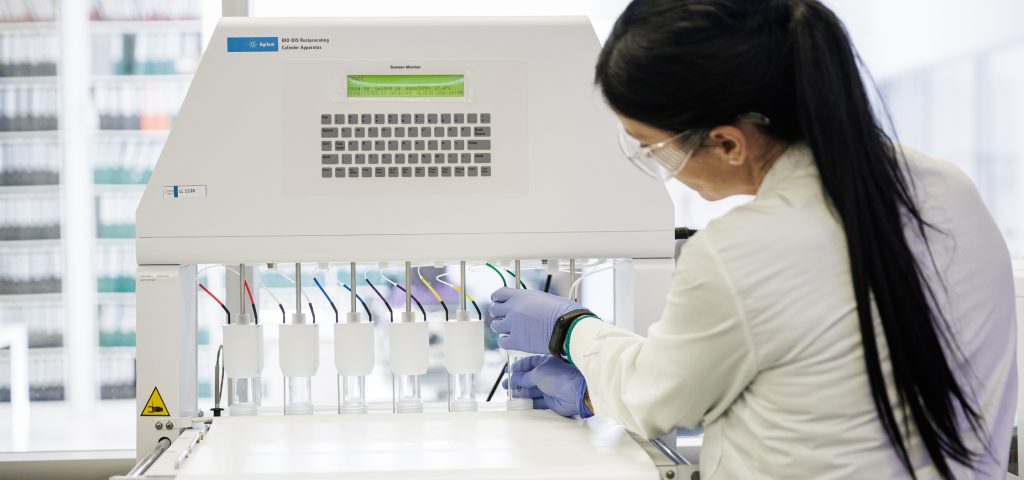
Image source: Adragos Pharma
This convergence is not just scientific; it’s reshaping how we think about manufacturing, regulatory frameworks, and patient-centric design.
Integrating Synthetic Chemistry with Biologics Platforms
Integrating Synthetic Chemistry with Biologics Platforms
This integration refers to the blending of chemical synthesis techniques with biologically derived components. Examples include:
- Antibody-Drug Conjugates (ADCs): These combine a monoclonal antibody (biologic) with a cytotoxic small molecule (synthetic) via a chemical linker. Manufacturing requires both biologics capabilities (e.g., cell culture, purification) and high-precision chemical conjugation.
- Peptide-Small Molecule Hybrids: These leverage the receptor specificity of peptides with the pharmacokinetic advantages of small molecules.
- mRNA and LNPs: mRNA is biologically encoded, but its delivery via lipid nanoparticles (LNPs) involves complex synthetic chemistry and formulation science.
This hybridisation demands cross-disciplinary manufacturing platforms—facilities that can handle both biologics (e.g., aseptic processing, cell culture) and synthetic chemistry (e.g., high-potency handling, solvent recovery) under a unified quality system.
Evolving Manufacturing Strategies
To accommodate these complex modalities, manufacturing must become:
- Modular and Flexible: Facilities must support rapid changeovers between biologics and synthetic processes, often within the same suite.
- Digitally Integrated: AI and machine learning are being deployed for predictive process control, enabling real-time adjustments based on multivariate data (e.g., cell viability, impurity profiles, reaction kinetics).
- Platform-Based: Rather than building bespoke processes for each molecule, companies are investing in platform technologies (e.g., plug-and-play mRNA synthesis, universal linker chemistries) to accelerate development and reduce cost.
The Role of Patient Population
Patient population characteristics are increasingly influencing manufacturing strategy:
- Rare Diseases: Small, genetically defined populations benefit from biologics or gene therapies, but require low-volume, high-complexity manufacturing—often in single-use or modular systems.
- Chronic Widespread Conditions: These still favour small molecules due to their oral bioavailability, cost-effectiveness, and ease of distribution.
- Personalised Medicine: As we move toward n=1 therapies (e.g., autologous cell therapies), manufacturing must become decentralised, automated, and highly traceable, with digital twins and AI-driven batch release becoming essential.
Bottom Line: The choice between small and large molecule manufacturing is no longer binary. It’s a strategic calculus that must weigh therapeutic goals, patient population, regulatory landscape, and technological maturity.
Contact us today to learn more about our services and how we can help you achieve your project goals.
Get in touch