
News
Scitech Awarded Construction Contract for New HRPD-X Facility at the Rutherford Appleton Laboratory in Oxfordshire
Scitech is proud to announce it has been awarded the construction contract for the new High-Resolution Neutron Powder Diffraction (HRPD-X) facility at the Science and Technology Facilities Council’s ISIS Neutron and Muon Source (ISIS), a world-leading centre for physical and life sciences research. This follows its successful delivery of the scheme and detailed design phases.
Part of ISIS’s Endeavour Programme, funded by UK Research and Innovation, this milestone marks a significant step forward in the development of one of the world’s most advanced high-resolution powder diffraction neutron instruments.
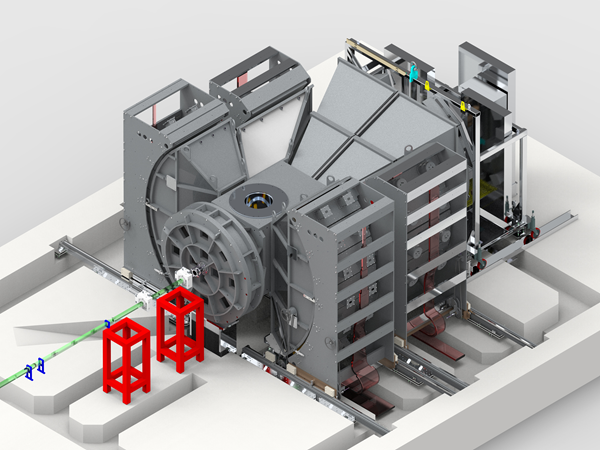
This instrument is a key research tool in understanding materials and uses neutrons to study their structure. It enables scientists to see how atoms are arranged and how those arrangements change under different conditions such as temperature and, pressure. It excels at observing the subtle structural changes that can have a huge impact on physical properties.
After 40 years of operation with the collection of over 80,000 measurements spread over some 2000 experiments, HRPD closed in December 2024 to commence three years of work on a comprehensive upgrade of the instrument. Following the demolition of the R69 building the new HRPD instrument will be installed in a brand-new building, R132.
The new two-storey facility will be constructed on the existing site and will house a state-of-the-art Instrument Hall, Control Room, Meeting Room, Laboratory, and staff welfare facilities.
Engineering Challenges
Several key features required in the new building presented unique challenges for Scitech’s design engineers. These included:
- Building size and footprint to be increased, but with no impact on existing vehicular access, whilst maintaining the theoretical sample position location of the instrument as building datum.
- A fully removable interlocking concrete mezzanine floor within the Instrument Hall.
- Installation of a 6.3-tonne overhead crane for mezzanine panel removal and instrument installation and maintenance.
- Enhanced vertical movement from the main entrance lobby, including an internal pedestrian lift and a 1000kg external equipment lift.
- Radiation shielding integrated into the building design.
- Re-cladding and partial reconstruction of the existing Guide Tunnel.
- A strict non-magnetic zone within the heart of the building
Access into the Instrument Hall is via large folding doors to remove equipment or instruments using the over-head crane system. The large folding doors split, with the ground floor becoming large openable doors.
Enabling scientific discovery has been the architectural driver, with the entire building essentially designed as a precision-engineered envelope for a single, highly specialised instrument. Scitech led the scheme and detailed design phases, including architectural layout, structural engineering, and integration of specialist systems such as radiation shielding and crane infrastructure.
The construction phase will begin in the coming weeks with the demolition of Building R69, followed by ground-breaking and piling works. The new HRPD instrument is scheduled for installation in Building R132 in late summer 2026.
This facility will support cutting-edge research in functional materials, including applications in batteries and electronic components to support a sustainable high-tech economy. The HRPD upgrade will significantly increase detector coverage and measurement speed, whilst also enabling measurements in an applied magnetic field, something that was previously impossible on HRPD, maintaining the UK’s leadership in neutron diffraction science.
For more information about the HRPD-X project, visit the project page.
Contact us today to learn more about our services and how we can help you achieve your project goals.
Get in touch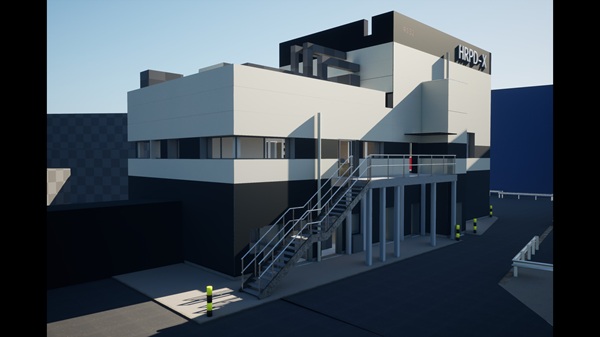
A rendition of how the new building will look.